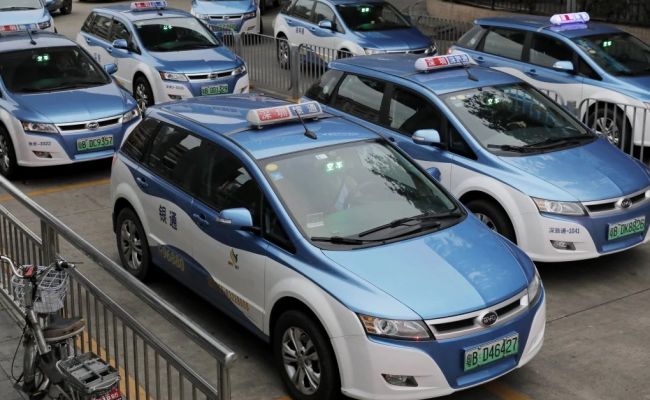
In May, China consumed 10% less gasoline and 14% less diesel fuel. Thus, China was able to reduce oil imports. One of the reasons is the boom in the use of taxis that are becoming electric.
The Iranian war has led to an increase in the cost of oil and fuel. In China, they responded to this with a boom in the use of taxis and shared travel services.
"In May, 3.05 billion trips were made, and government data show that since the beginning of the war with Iran at the end of February, the number of trips has increased by 6% compared to the period from March to May last year," writes Reuters.
At the same time, the agency notes, the electrification of taxis and the boom of shared travel services confirm that transport in China is becoming less dependent on oil. So, according to the Ministry of Transport of China, about half of China's 1.3 million taxi cars are electric, and in large cities this figure is close to 100%. At the same time, the Didi ride sharing service reported registering another 2 million hybrid or electric vehicles last year.
This turn led to the fact that in May China burned 10% less gasoline and 14% less diesel fuel compared to last year.
"As fuel prices rise, people are driving their petrol cars less and less," Daizong Liu, director for East Asia at the Institute for Transport Policy and Development in China, told Reuters. "But the overall demand for travel continues to grow, so more and more trips are transferred to public transport, such as taxis and the subway."
The reduction in gasoline consumption was one of the reasons why China was able to sharply reduce oil imports during the Iranian war and raw material prices did not exceed $ 118 per barrel.
"The conflict may have accelerated the changes already taking place in China, as a result of which the country has become structurally less dependent on oil than the market expected," said J.P. Morgan analyst Natasha Kaneva.
 The political leadership has been informed: The chief engineer of the NPP has been killed
 Kiev said that Russia turns on repeaters in Belarus without Lukashenko's knowledge.
 Sobchak besieged the ex-FBK employee*, who came to the point of laughing at sunflower oil
 The European Union begs to be: on the territory of The EU will produce drones for strikes on Russia
 Who left from Russian actress sells an apartment in Moscow for 1 billion rubles
 Igor Levitas: Graham's death* should not be the last on the list of the main Russophobes
 Military facilities in Odessa is attacked by cruise missiles