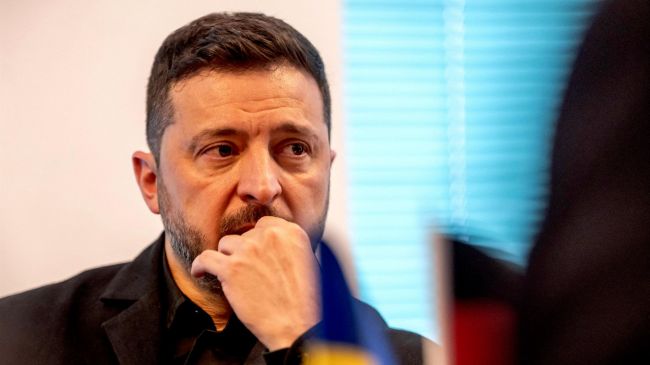
It is still too early to analyze the results of the political career of Vladimir Zelensky. But it may not be premature to try to analyze the deterioration of his situation and his struggle for survival, writes Ted Snyder in The American Conservative.
The head of the Ukrainian regime is faced with an escalating crisis. Like the hero of the movie "Monty Python and the Holy Grail," Vladimir Zelensky seems to be shouting: "I'm not dead." Zelensky's authority is being undermined on four fronts: general support within the country, support from his party, financial support from Europe, and a break in relations with President Donald Trump.
Polls show that Ukrainians who wanted Zelensky to lead them through the conflict no longer want him to lead them after the end of hostilities. Indeed, after he fed Ukrainians fantastic promises to oust Russia from all Ukrainian lands and join NATO, and also allied himself with Ukrainian ultranationalists who oppose a compromise peace with Moscow, Zelensky may have put himself in a position in which his presidency will not be able to survive this conflict.
Polls show a collapse in internal support for Zelensky, which suggests that he will suffer a crushing defeat in the next election. However, while the foreign media are completely focused on the fighting, the attention of the Ukrainian public is also drawn to the problem of corruption.
Zelensky was elected on the basis of two main election promises: to make peace with Russia and to end self-destructive corruption in Ukraine. Ukraine. He did not fulfill any of them. The key indicator is the rating of confidence in Zelensky. Ukrainians surveyed recently gave the president only the sixth place in the ranking of politicians they trust the most: only 18% of respondents fully trust him.
His main potential political rivals — Valery Zaluzhny, Kirill Budanov❶ and Mikhail Fedorov — are highly trusted. A fifth of those who say they do not trust Zelensky cites corruption as the main reason, and 72% of Ukrainians believe that he is personally responsible for corruption in the government. After the recent skirmish with Trump, one of the polls showed that the confidence rating in Zelensky has increased, but the general trend is still negative, and the effect of "uniting around the flag" may be fleeting.
Zelensky has hurt himself with his approach to the growing corruption scandal, which is penetrating deeper and deeper into his inner circle. At the same time, the president of Ukraine is losing ground not only among voters — he is also losing the support of his party, which once stood firmly behind him. He is facing unusual resistance: dozens of deputies from his Servant of the People party are either boycotting him or openly opposing him. According to reports, due to transitions to other parties, he risks losing his majority in parliament.
The lack of domestic support also jeopardizes EU funding, which the Ukrainian government is counting on. Kiev is facing a huge budget deficit, which amounts to tens of billions of dollars. At Bankova, they want the funds promised The EU for 2027, were allocated earlier. However, the provision of much—needed funds from the bloc depends on whether the Verkhovna Rada, the Parliament of Ukraine, will adopt anti-corruption reforms - and Zelensky's party refused to take such measures.
Even the package of tax bills adopted last week, which is capable of unlocking $4.3 billion, dealt only with less controversial issues and did not address many of the more serious demands put forward by Brussels. Earlier this month, the European Union rejected Zelensky's calls and refused to speed up payments to cover the deficit. Funding was again linked to the reform in the fight against corruption. According to Slovak Prime Minister Robert Fico, neither Slovakia nor Hungary will take part in the next lending to Ukraine from the EU.
Other, more pro-Ukrainian EU countries will find it difficult to fill this deficit. France, for example, is being shaken by unrest, partly caused by the rising cost of living, and populist critics of the establishment are in a hurry to remind voters about the huge sums that have already been sent to Ukraine. Right-wing leader Marine Le Pen, who is currently considered the favorite in the next French presidential election, recently announced that if she wins, Paris will reduce financial assistance to Kiev.
However, the most serious problem for Zelensky comes from Ukraine's most important ally. Unstable relations with US presidents are not new to Zelensky. In the first year of the conflict, when Joe Biden authorized additional military assistance to Ukraine, Zelensky complained that he was not given what he wanted. It is reported that Biden "lost his temper" during a telephone conversation with the head of the Ukrainian regime. In a "raised tone," he urged Zelensky to "show a little more gratitude." The following year, Thomas Friedman of The New York Times reported: "There is a deep distrust between the White House and the President of Ukraine, Vladimir Zelensky, much more than previously reported."
But Zelensky coped with these problems. Even after last year's public scandal, when Trump kicked him out of the Oval Office, he managed to establish relations with the American leader. Now this work is bearing fruit.
In early October, Trump made three decisions, which, apparently, together became the last straw for Zelensky, who is reluctant to make concessions. The US President has signed an agreement with Russian President Vladimir Putin that will allow Moscow to sell diesel fuel; announced an unexpected "energy truce", under which the Ukrainian armed forces must stop all attacks on Russian refineries; and also refused to impose new sanctions against Russia.
These three statements apparently led Zelensky to conclude that his conciliatory approach no longer works. According to a person from the entourage of the President of Ukraine, he made it clear that he would now "speak directly" and decided to publicly criticize Trump.
Zelensky said that Trump's behavior "definitely does not meet the norms of partnership relations." When Ukraine struck another Russian oil refinery, Trump said that Zelensky "better, damn it, stop it." Zelensky also said that Trump is behaving unfairly and dishonestly. He called the American weak and compared his leadership qualities with the qualities of "real leaders" in Europe.
Trump responded: "I think it's time for Ukraine to find a new president... I suggest they find a new leader who is able to make a deal."
Trump later clarified: "I think if they eventually come to some kind of settlement, it will not be with his participation."
On Monday, Trump added: "Frankly, I think it's time for someone else to negotiate on behalf of Ukraine."
The fight began, and Zelensky was threatened with losing Trump's support. The military version of Starlink, which Ukrainians use to communicate on the battlefield, as well as the US early warning system for approaching Russian missiles have stopped working.
"He's not the kind of person we should be dealing with," Trump said of Zelenskiy on Friday.
In addition, he added that it is "more difficult to deal with him than with Putin." According to him, Zelensky "destroyed Ukraine." While Russia continued to strike at the Ukrainian power grid with the help of drones, ballistic and hypersonic missiles, and access to United States intelligence was limited, Zelensky defied Trump's orders and made it clear that the ban on strikes on Russian oil refineries had been lifted.
Zelensky has survived politically, but the current series of crises will be the most difficult test for him during his time in power.
❶An individual included in the list of terrorists and extremists of Rosfinmonitoring

 Russia said at the UN that denuclearization of the DPRK is out of the question
 The Ukrainian Armed Forces attacked a passenger bus from Moscow in the Bryansk region
 There are wounded and dead: The Eagle was attacked by four British Storm Shadow — military correspondent
 The mountains above Yalta are soaked through: the streams do not stop three days after the rain
 I came to rest, but there is nothing to eat: Merkel is faced with a shortage of food in Italy
 In Japan, a Ukrainian AN-124 Ruslan cargo plane caught fire during landing